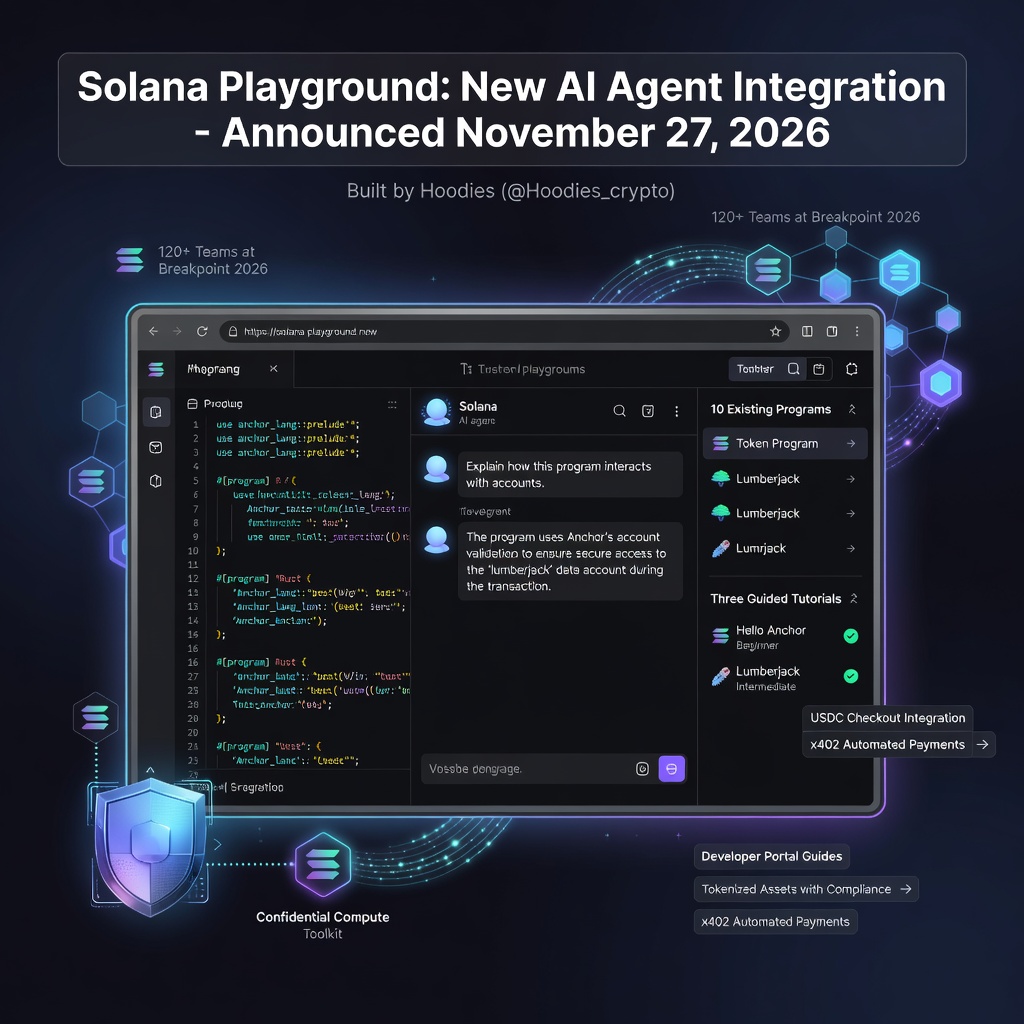
Solana announced a new version of Solana Playground on November 27, 2026, that lets developers ask an AI agent to explain or edit code in the same browser workspace they use to write and deploy programs. Solana Developers credited Hoodies, who uses the handle @Hoodies_crypto on X, with building the platform.
Two ways to write a Solana program
Solana’s demonstration showed two options for starting a project: use the Anchor framework or write a native Solana program. Solana calls its smart contracts programs. They execute instructions, while separate accounts hold application data. Anchor provides tools for specifying which accounts a program can access and checking the information supplied in a transaction. Native development gives programmers more direct control without those abstractions.
Developers can also explore 10 existing programs or follow one of three guided tutorials. These include Hello Anchor, an introduction to the framework, and Lumberjack, an intermediate project. In each case, developers can use the conversational interface to ask how unfamiliar code works or request changes.
The AI integration is new; browser-based deployment is not. The earlier open-source Solana Playground, also called SolPg, let developers compile Rust programs, manage development wallets and deploy contracts without installing a local toolchain. According to the Anchor documentation, developers using that Playground can create a browser wallet, obtain test SOL from a faucet on Solana’s developer network, then deploy and test a program without spending real funds.
Developer resources beyond Playground
Solana’s developer portal also provides instructions that programmers can give their preferred AI coding tools to configure an environment and use Solana libraries. Its application guides cover issuing tokenized assets with compliance controls, accepting USDC at checkout and automating payments with the x402 protocol.
The Playground announcement followed the launch of solana.ai, a platform for autonomous trading, wallet management and stablecoin payments reported on November 23. At Breakpoint 2026, the Solana Foundation said more than 120 teams were developing AI products in the ecosystem.
Earlier in November, the Foundation introduced Confidential Compute, an open-source toolkit developed with Nito. It lets AI applications process sensitive information in protected hardware while recording hardware verification data on Solana. Separately, the Foundation outlined 11 startup ideas in areas including AI inference, stablecoin payments, tokenized collectibles and housing futures. Teams pursuing those ideas can apply through Solana’s Builder Program for grants, technical resources, marketing and hiring support, and infrastructure credits.