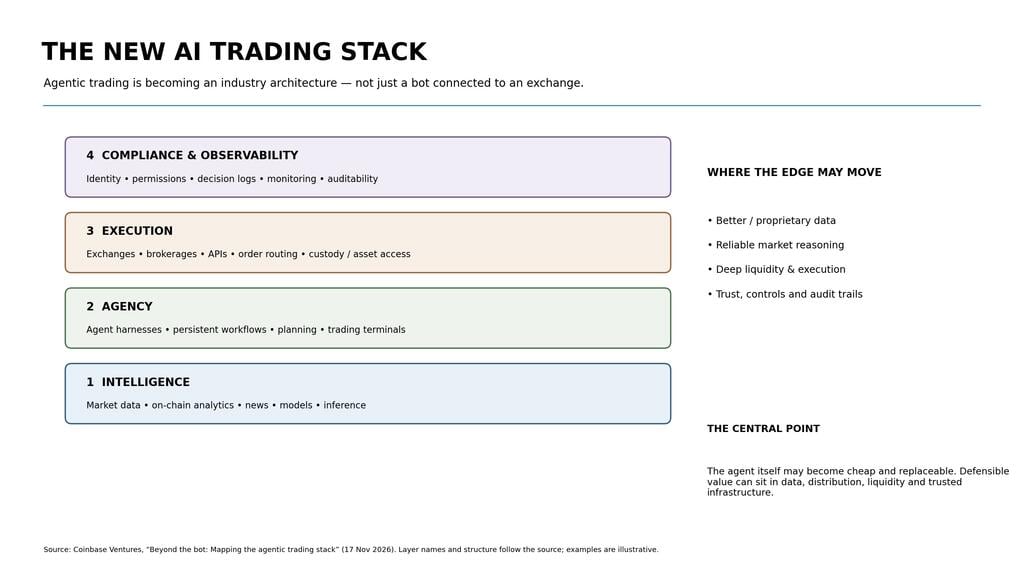
In August 2026, Binance launched Agent OS, giving developers access to exchange data and trading functions through AI agents. In November, Coinbase Ventures mapped the tools used to build such systems, from data sources to trade execution and compliance. The distinction from earlier trading software is who chooses the trade: rather than specify what to buy or sell when a condition is met, a user can give an agent a goal, such as hedging a position, and leave individual decisions to it around the clock.
Consider a token promoted on social media. An agent could scan posts and wallet activity, spot unusual volume and act on momentum before a trader following a chat room has time to respond. But if many agents identify the same signal, faster execution could intensify the rush into the token and the reversal that follows. That is a risk, not a demonstrated effect of the Binance launch.
What the trading studies show
A February 2026 study in the Journal of Futures Markets identified sub-second patterns in Bitcoin and Ether spot and perpetual futures markets consistent with algorithmic trading for liquidity. The researchers found higher volatility and trading costs, but no significant effect on prices. The study concerned algorithmic trading, not specifically AI agents.
A separate 2026 study in Frontiers in Blockchain examined machine-learning strategies using crypto market data. Many strategies fit historical data too closely and offered retail traders no viable advantage once realistic fees were included. A strategy that performed well on one cryptocurrency did not necessarily work on another. Processing a signal faster does not resolve those weaknesses or establish whether the story behind a price move is true.
Who controls the risk?
Institutions remain a source of capital, liquidity and price discovery, particularly in Bitcoin. A 2026 study using Bitcoin data from 2012 through 2025 found that trading volume rose, transaction costs fell and market efficiency improved as the market matured. Wintermute reported that institutional clients accounted for 72% of spot volume on its over-the-counter desk in the first half of 2026. That share describes Wintermute’s desk, not the wider crypto market.
Institutional traders can monitor unusual order flow across venues and limit their exposure. They cannot control a round-the-clock market whose liquidity is spread across exchanges and derivatives markets. The Binance AI rollout also highlighted the risk that an agent could be influenced by instructions embedded in its inputs, and the difficulty of seeing why an external agent chose a trade.
The likely shift is in the division of work, not the disappearance of traders. Agents may take on more execution and searches for short-lived trading opportunities, while people decide how to allocate capital, what research to trust and which bots have permission to trade. That distinction matters most under stress: competing systems may narrow trading spreads in ordinary conditions, yet funds using similar risk controls could all try to exit at once, deepening a decline.