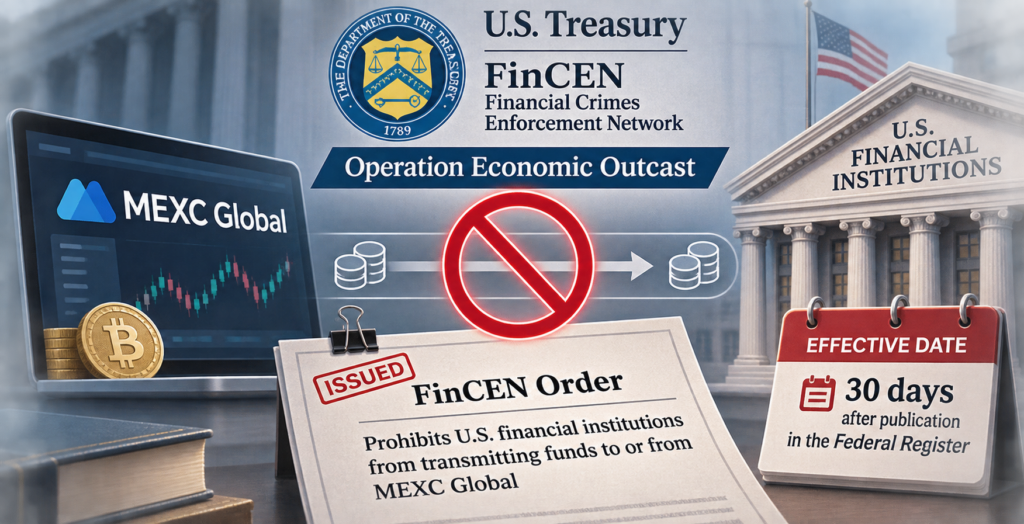
In an announcement published November 7, 2026 (UTC+8), the U.S. Treasury said its Financial Crimes Enforcement Network (FinCEN) had issued an order barring U.S. financial institutions from transmitting funds to or from crypto exchange MEXC Global. The action was part of Operation Economic Outcast.
The order was issued, but its restrictions were not yet in effect at the time of the announcement. FinCEN said they would take effect 30 days after the order’s publication in the Federal Register. Issued under section 9714(a) of the Combating Russian Money Laundering Act, the order applies to U.S. financial institutions; the announcement did not describe it as a general ban on trading through MEXC Global. Violations may carry civil or criminal penalties. Existing Bank Secrecy Act obligations and sanctions administered by the Treasury’s Office of Foreign Assets Control (OFAC) remain unchanged.
Treasury alleged that MEXC Global facilitated at least $16 billion in transactions connected to sanctions evasion, cybercrime and other illicit activity between May 2021 and May 2026. According to Treasury, that total included nearly $1.5 billion linked to Russian sanctions evasion, with $232 million in direct transactions involving entities sanctioned by the United States, European Union or United Kingdom. Treasury also said the exchange processed transactions involving Garantex and its successor, Grinex, as recently as June 2026.
Treasury further reported approximately $1 billion in direct transactions between MEXC Global and more than 40 identified Iranian crypto exchanges over the same five-year period. It attributed approximately $22 million in transactions to activity benefiting the sanctioned Central Bank of Iran and the Islamic Revolutionary Guard Corps and its Qods Force. MEXC Global claims to maintain anti-money-laundering and customer-verification policies, but Treasury said deficiencies in its controls allowed transactions involving prohibited jurisdictions.