
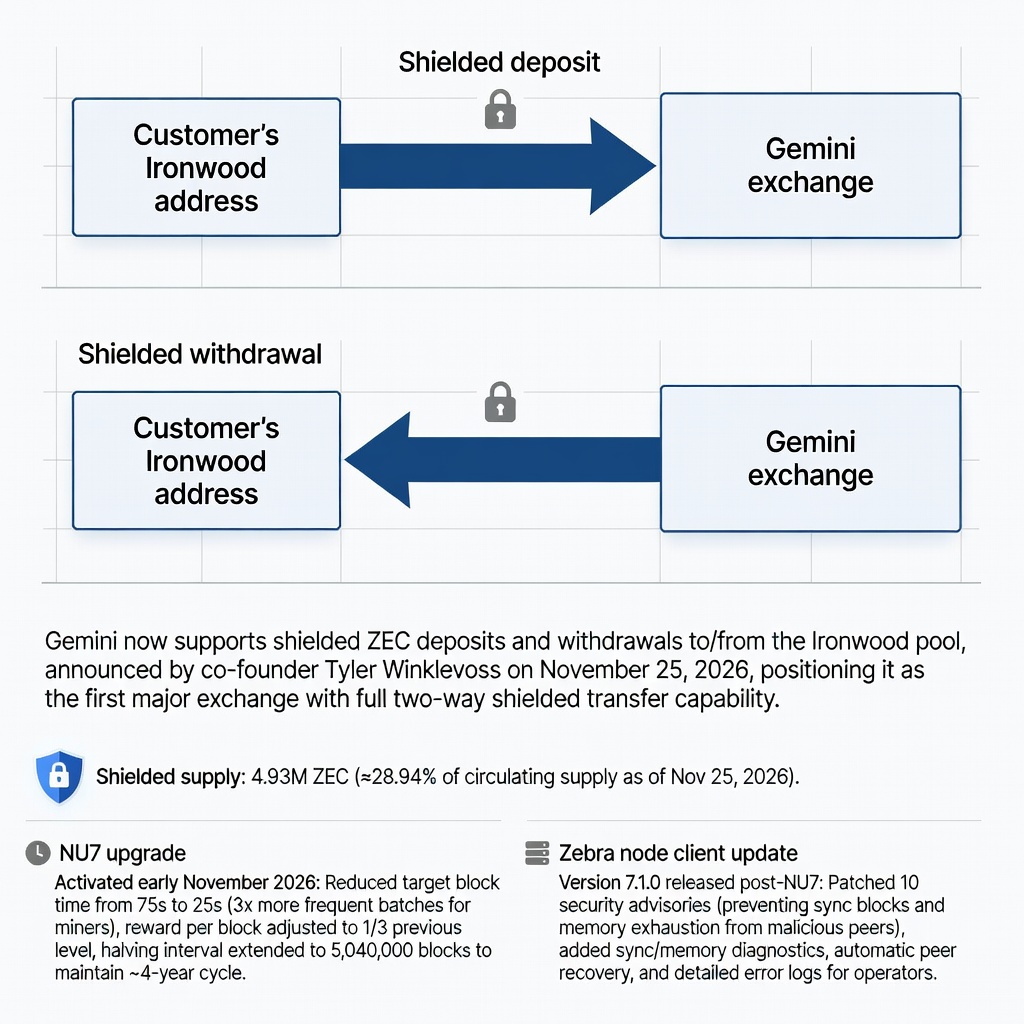
Gemini began accepting shielded Zcash (ZEC) deposits on November 25, 2026. Customers with verified accounts can now send ZEC to a shielded deposit address at Gemini as well as withdraw it to a personal address in Zcash’s Ironwood pool.
Co-founder Tyler Winklevoss announced the deposit feature. Gemini had enabled shielded withdrawals in July, shortly after the Ironwood upgrade (NU6.3) activated on July 28 at block 3,428,143. Until the deposit feature went live, customers could send ZEC out of the exchange through the pool but still needed a transparent address to send funds in. In a November 25 post on X, analyst Scott Melker relayed Gemini’s claim that it was the first major exchange to support shielded transfers in both directions.
Across the Zcash network, approximately 4.93 million ZEC was held in shielded form on November 25, representing about 28.94% of circulating supply.
Shorter block times, unchanged issuance
Zcash activated a separate upgrade, NU7, in early November 2026. It cut the target block time from 75 seconds to 25 seconds. According to the protocol documentation, that gives miners three times as many opportunities to include batches of transactions in the blockchain over the same period.
NU7 kept scheduled issuance unchanged by reducing the reward per block to one-third of its previous level. It also extended the interval between reward halvings from 1,680,000 blocks to 5,040,000 blocks, preserving the roughly four-year cycle despite the shorter block time.
A few days after NU7 activated, the Zcash Foundation released version 7.1.0 of its Zebra node client, addressing ten security advisories. According to the foundation’s technical notes, most fixes addressed problems that could allow a malicious peer to prevent a node from syncing or exhaust its memory. The release also added sync and memory diagnostics, automatic peer recovery and more detailed error messages for node operators.