An Anti-Corruption Data Collective (ACDC) report released on November 23, 2026, found that prediction markets called most US congressional races correctly in the 2026 midterms—but did not materially outperform a consensus of election models. Its analysis also found that profits in Polymarket’s congressional markets were concentrated among a small share of wallets.
The findings were reported on November 24, 2026. ACDC is a nonprofit focused on corruption and illicit finance, and its policy position is part of the context for the research: it advocates returning jurisdiction over prediction markets to US states. Co-founder David Szakonyi has called for Congress to ban election betting. The report was self-published with funding from the MacArthur Foundation.
Accuracy depended on the races examined
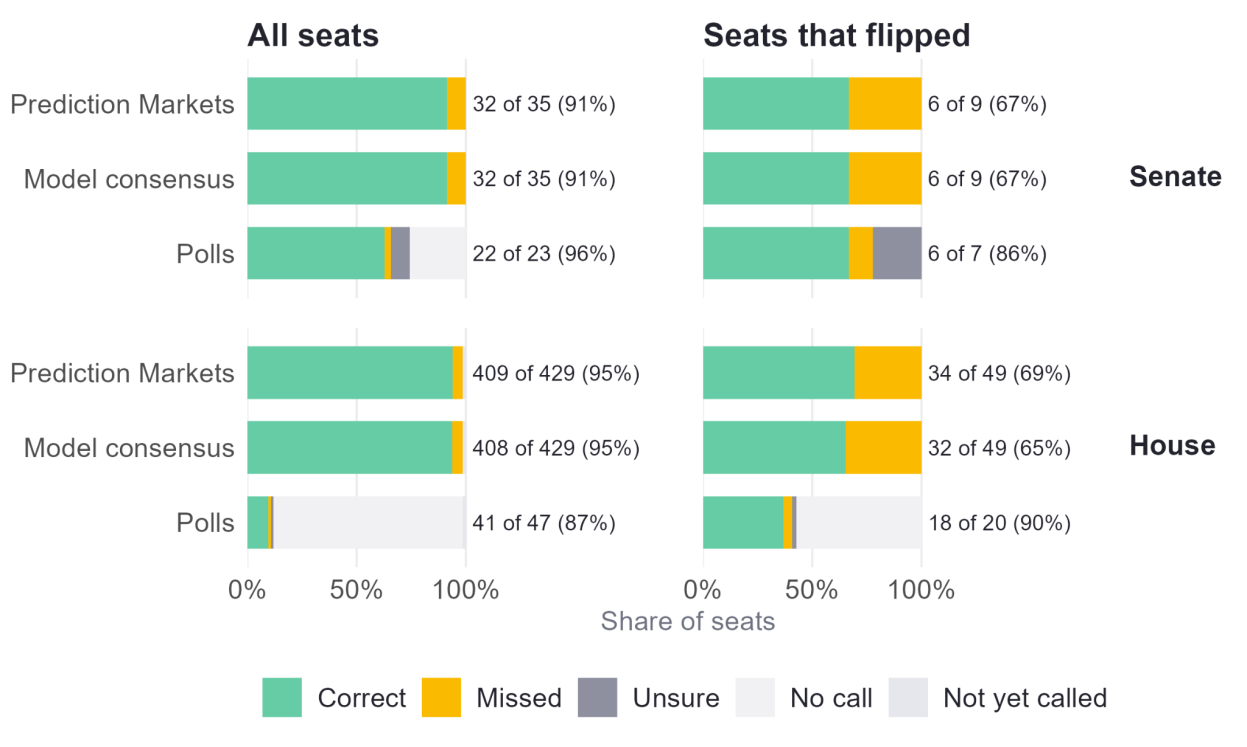
ACDC judged a market prediction using prices 24 hours before the first polling place opened: a candidate priced above 50 cents counted as the predicted winner. Of 470 congressional races, 464 had been decided by November 19 and six remained unresolved. Across the decided races, the markets called 32 Senate seats correctly and three incorrectly, for 91% accuracy; in the House, they called 409 correctly and 20 incorrectly, for 95%.
An equally weighted consensus of six election models—Silver Bulletin, Cook Political Report, ElectIt, RealClearPolitics, The Economist and FiftyPlusOne—also achieved 91% and 95% on those measures. ACDC said the markets’ advantage over the model consensus was 0.2 percentage points: markets were right where the models were wrong in three races, while the reverse happened in two.
For seats that changed party control, markets correctly predicted six of nine Senate seats (67%) and 34 of 49 House seats (69%). The model consensus scored 67% and 65%, respectively. Those small samples do not support a broad claim that markets performed worse in flipped races.
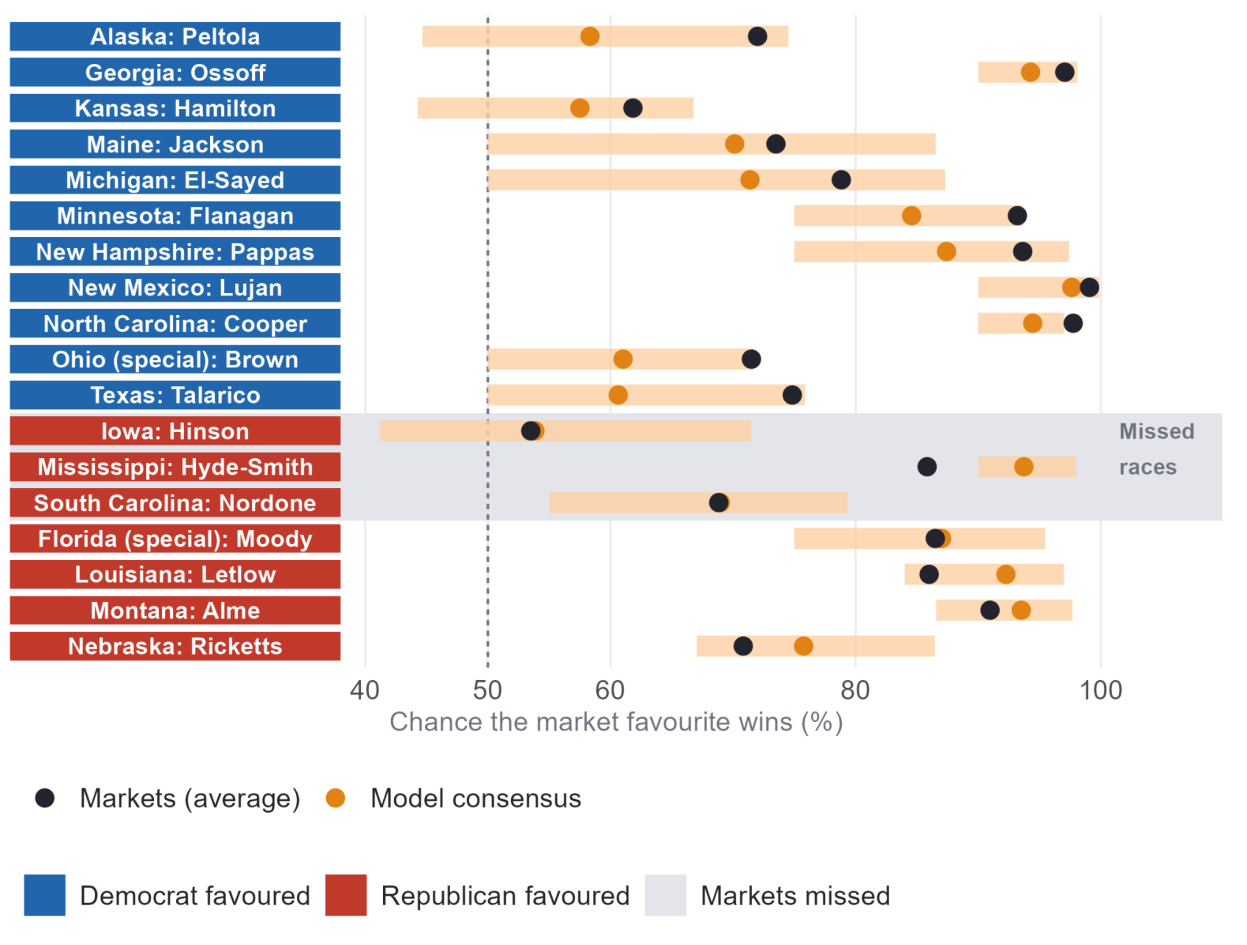
A different test highlighted difficulty in close markets. Among races with a leading candidate priced below 65 cents, Kalshi called 10 of 24 correctly (42%), Polymarket US 11 of 25 (44%), and Polymarket 13 of 25 (52%). Contracts priced above 85 cents produced only two incorrect calls. The flipped-seat and close-price groups measure different things; neither result cancels out the other.
ACDC also found that, a month before election day, model-consensus probabilities moved 1.5 percentage points in a typical race, compared with 3.3 points for average market prices. Just before the election, markets priced Democratic candidates six points higher on average than the models did. ACDC interpreted this as traders drawing on model information without the models drawing on market prices; the price movements alone do not establish that information flowed only one way.
Wallet-level results cover Polymarket, not all three platforms
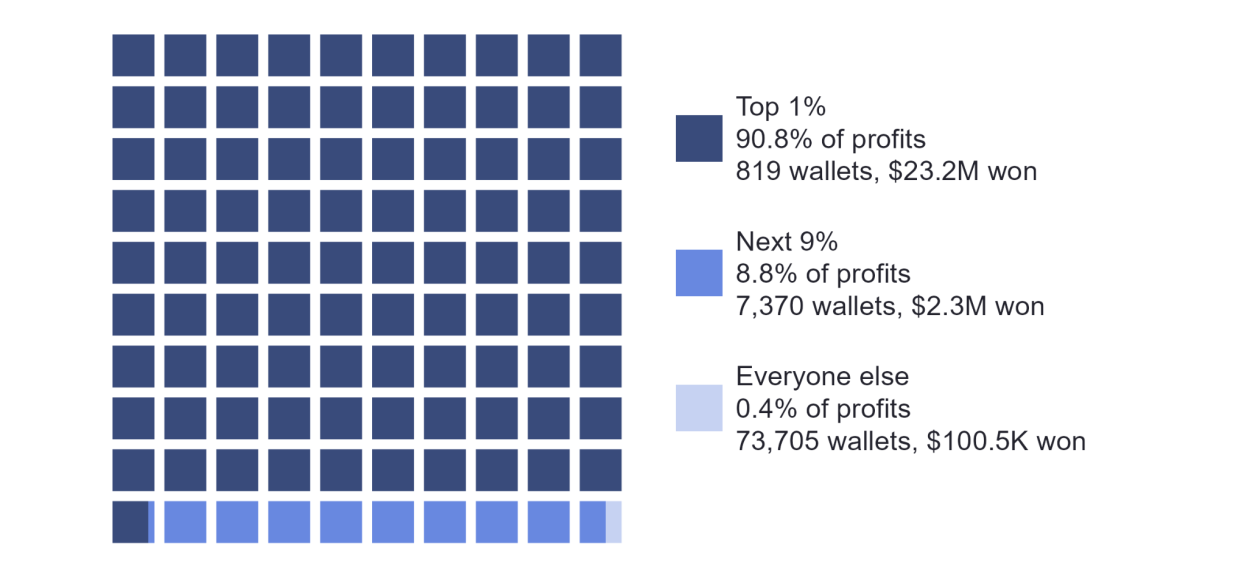
Polymarket was the only platform in the analysis with public wallet-level trading and profit-and-loss data. ACDC examined 5,946 settled congressional markets involving 81,894 distinct wallets. It found that 42,984 wallets lost money. The top 1%—819 wallets—received about 91% of total profits, or $23.2 million; the bottom 99% recorded a combined net loss of $15 million. The top 0.1%, comprising 82 wallets, received 55% of profits.
ACDC classified wallets using trading patterns and activity thresholds, not verified personal identities. Its “whale” category required more than $1 million in lifetime volume across over 100 markets; its bot classification used consistently distributed trading across hours. Together, the two categories comprised 6,824 wallets, or 8% of the total, but accounted for 45% of volume and 72% of profits.
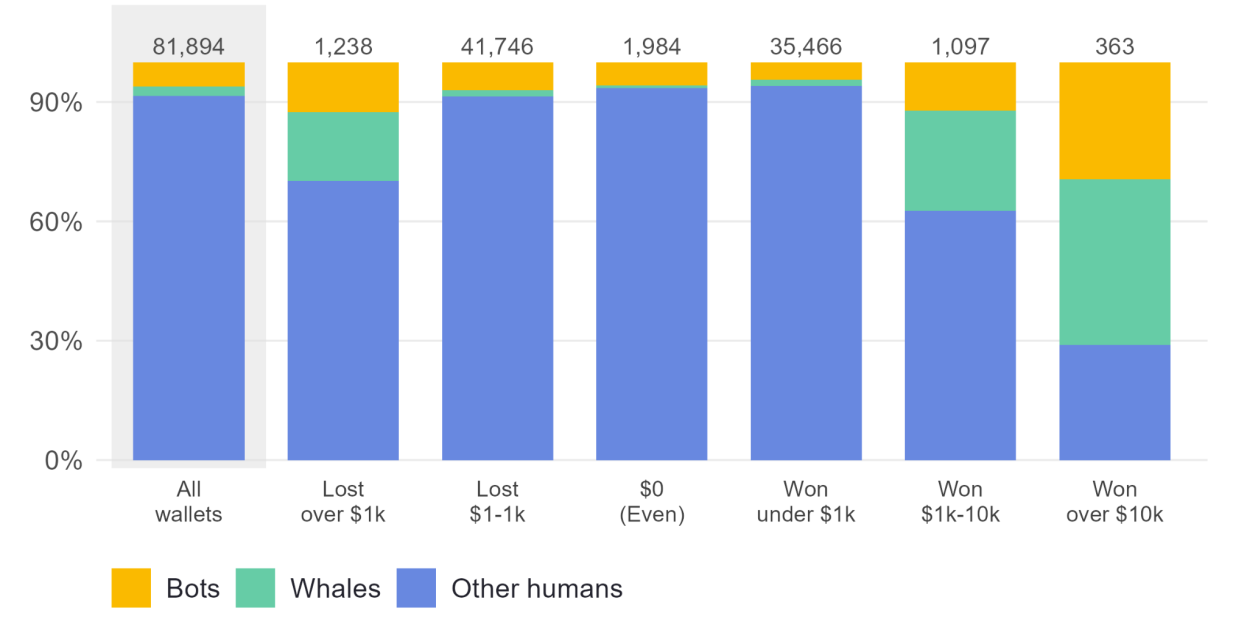
Some positions had not formally closed when ACDC compiled the figures, so it said the $15 million net loss may be understated. Wallets also cannot necessarily be equated with individual people. The report found that ordinary-user wallets made money during trading but lost most heavily at settlement after retaining losing contracts to expiry.
Fees, estimates and the US policy dispute
The three platforms recorded a combined $854.4 million in congressional-seat trading volume, including $183.2 million on Polymarket. Using daily fee schedules, ACDC estimated platform fees at $11 million to $14.1 million, with $11.7 million its best estimate. It estimated Kalshi’s share at $9.3 million to $10.8 million. These are estimates, not audited receipts; parts of the broader profit comparison also extrapolate from Polymarket data because equivalent Kalshi and Polymarket US wallet data were unavailable.
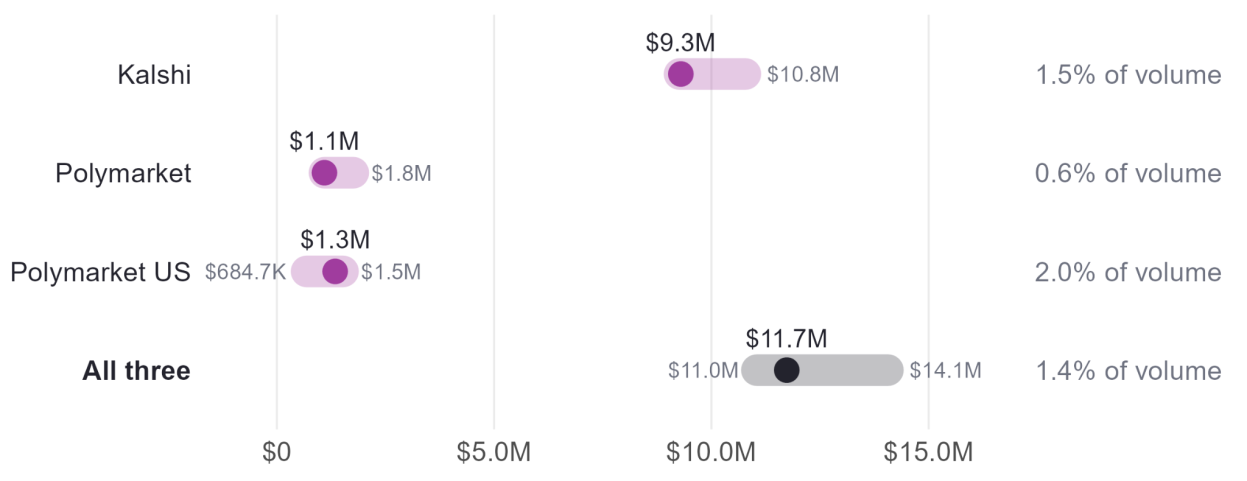
The platforms collect fees, while losses on incorrectly priced contracts go to the opposing side of trades, not automatically to the platforms. ACDC separately criticized platforms for announcing election results on social media before counting had finished.
The report arrived amid an unresolved US jurisdictional dispute. The original reporting noted that Arkansas sued Kalshi on November 4; a Louisiana court issued a temporary restraining order against Kalshi, Polymarket and other platforms on November 12; and the US Department of Justice and Commodity Futures Trading Commission sued Arkansas that same day. Those proceedings should not be mistaken for a nationwide rule or a final determination of the platforms’ legal status.