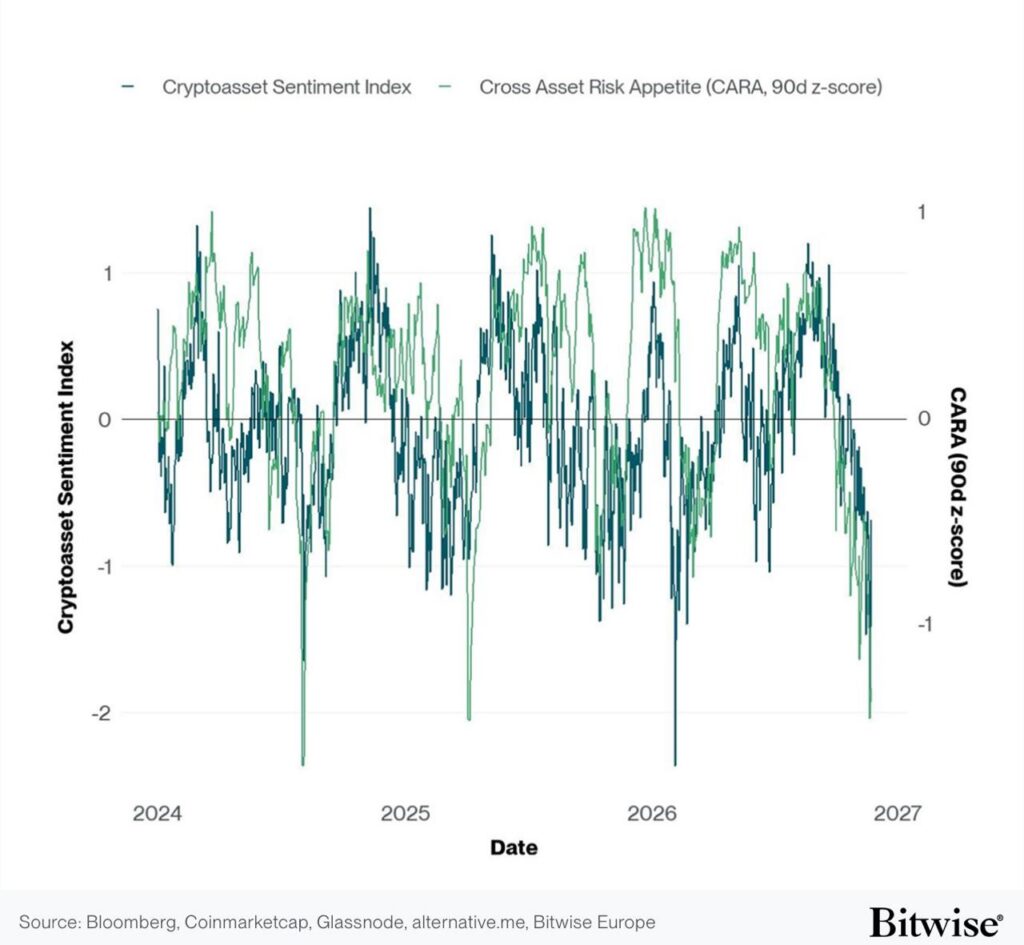
Bitwise’s Cryptoasset Sentiment Index fell to 1.88 standard deviations below its usual level on November 20, 2026, its weakest reading since February and one of the three lowest since FTX collapsed in November 2022. Only four of the index’s 15 indicators remained above their short-term trends. The separate Crypto Fear & Greed Index also remained in its extreme-fear range.
The figures come from Bitwise’s November 23 Crypto Market Compass. Its sentiment and on-chain data stop on November 20, before Bitcoin reached $55,130 on November 21. By that cutoff, traders were paying unusually high premiums for downside protection, but estimated weekly realized losses remained below those of the two previous major selloffs.
Bitcoin fell alongside stocks, but missed their rebound
Bitcoin lost about 10% over the week covered by the report, roughly matching the Nasdaq Composite. Ether fell 14% and the S&P 500 dropped 8.6%. Nvidia lost 22.9%, while TSMC fell 20.1% in its worst week since 2006. Gold and silver also declined, by 8.9% and 16%, respectively.
Bitwise’s gauge of risk appetite across traditional markets fell from −0.51 to −1.11 after reaching −1.14 midweek. The firm compared those levels with the mid-2024 yen carry-trade unwind and the early-2025 tariff selloff. The VIX, a measure of expected 30-day S&P 500 volatility, closed at 35.89 on November 20. That was its highest close of 2026, but below the August 2024 close of 38.57 and the April 2025 close of 52.33. On November 23, the Nasdaq rebounded 6.5%, while Bitcoin gave up its intraday gains.
Bitwise attributed the broad decline to changing expectations for US interest rates and discounted the Binance hack as a driver because it had occurred several weeks earlier. According to the firm, federal funds futures implied a 93% chance of a December rate increase and a 63% chance of two more increases by January 2027. Minutes of the Federal Open Market Committee’s October meeting showed that almost all officials expected further tightening. Federal Reserve Governor Christopher Waller raised the possibility of a half-percentage-point increase in December; it was not a committee decision.
Bitwise said its measure of the tone of Fed officials’ public comments had returned to levels last seen in 2021. The 10-year Treasury yielded 4.95%, just 29 basis points more than the two-year yield of 4.66%. Bitwise argued that a large December increase would likely push short-term yields above long-term yields. It noted that such inversions have usually been followed by a pause and later cuts, but the Fed itself had not signaled a pause.

Paper losses and realized losses tell different stories
In the 14 days through November 20, the share of Bitcoin supply held at a profit fell from 59.1% to 43.2%. It had been lower on only 99 of the preceding 5,970 days. Bitwise estimated that about $953 billion in invested capital was held at a loss, comparable to the level around the FTX collapse. These measures use the price at which each coin last moved: they describe the supply of coins, not the percentage of investors who lost money.
Coins moved at a loss on November 20 accounted for an estimated $1.36 billion in realized losses, a daily figure exceeded on only 18 earlier days. Realized profits amounted to about 15 cents per dollar of realized loss. Over seven days, losses totaled $5.3 billion, against roughly $5.7 billion in November 2025 and $9.1 billion in February 2026. A transfer between wallets need not be a sale, so the figures do not establish how much Bitcoin holders sold or whether selling was over.
The November 21 low of $55,130 took Bitcoin below its late-June trough near $58,000 and to its lowest price since September 2024. It subsequently recovered to about $61,000. The low approached Bitwise’s realized price of about $53,500, the average price at which all coins last moved. The median was higher, at about $64,300: half of all coins last moved above that price. Bitwise identified long-term holders’ average cost of about $47,000 as a further reference if Bitcoin fell below the realized price, not as its base case.

Options traders paid for protection as US funds saw redemptions
Perpetual futures open interest fell about 4.5% to roughly 439,000 BTC. Annualized funding dropped from 6.6% to about 1.7%, and the three-month futures premium narrowed from 5.2% to about 4.5%. Combined liquidations totaled about $4.9 billion. On CME, commercial traders cut their net short position from 11.11% to 7.28% of open interest. Bitwise interpreted that shift, alongside an improvement in its measure of leveraged Bitcoin longs, as evidence that some leveraged buyers had already been forced out. More coins also moved onto exchanges, which the firm associated with possible selling, though it gave no inflow volumes.
Options open interest, by contrast, rose about 18.5% to roughly 548,100 BTC. The put-to-call ratio on crypto-native exchanges reached 0.83, near the 99.9th percentile of its three-year range. For every maturity from one week to six months, the premium traders paid for puts over comparable calls was at or above the 99th percentile on the 25-delta skew measure.
Every major US spot Bitcoin ETF in Bitwise’s data recorded redemptions during the week. Net outflows totaled $1.84 billion, of which BlackRock’s IBIT accounted for $1.37 billion, or about three-quarters. Grayscale’s GBTC recorded $119.3 million in net outflows and Bitwise’s BITB recorded $43.6 million. US spot Ether ETFs had net outflows of $288.4 million.
Bitwise said similarly low sentiment readings had historically preceded strongly positive 12-month returns, but it provided neither a sample size nor a hit rate. The index therefore does not establish the likelihood of a recovery. More immediate tests include whether ETF redemptions ease, whether realized losses rise if Bitcoin revisits its realized price, and what the Fed decides in December.