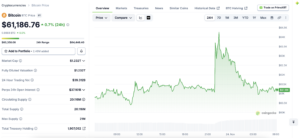
In a weekly analysis reported on November 23, 2026, Bitfire Research said Bitcoin’s recovery toward $60,000 had not reversed a bearish technical outlook. The firm pointed to continued withdrawals from U.S. spot Bitcoin exchange-traded funds, cautious positioning among U.S. investors, and a difficult macro backdrop ahead of the Federal Reserve’s December meeting. It said institutional selling and weak sentiment still showed little evidence of sustained buying after the rebound from the November 21 lows.
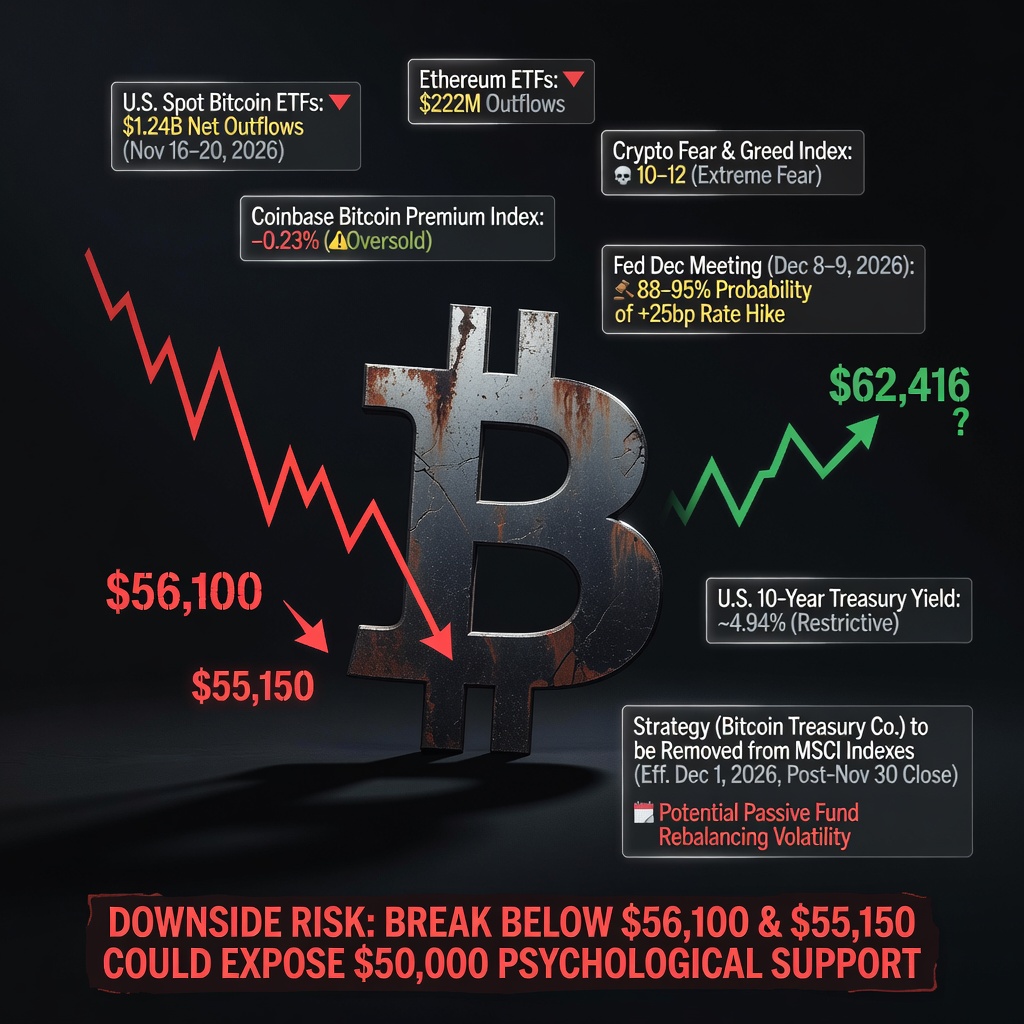
The downside case was conditional. Bitfire said Bitcoin could fall toward $50,000 if it broke support at $56,100 and a recent low near $55,150. On the other side of the same technical note, a recovery above $62,416 with stronger trading volume could open a path toward $65,000 and then $69,300. Those levels were the firm’s scenario, not an observed move.
U.S. ETF outflows and sentiment
Bitfire said U.S. spot Bitcoin ETFs recorded approximately $1.24 billion in net outflows between November 16 and November 20, 2026, extending three consecutive weeks in which withdrawals exceeded $1 billion. Ethereum ETFs were under similar pressure, with roughly $222 million leaving those funds over the same period.
The firm described the latest withdrawals as following an already difficult start to November. Separate earlier reporting had put Bitcoin ETF losses at $2.89 billion through November 18, with BlackRock’s IBIT accounting for approximately 83% of those withdrawals.
Bitfire found that the Coinbase Bitcoin Premium Index fell as low as negative 0.23%, which it read as U.S. investors selling Bitcoin at a discount to prices on other exchanges. The Crypto Fear & Greed Index stayed between 10 and 12 through the week covered by the note, a range the report placed in extreme fear. Earlier in November 2026, Bitcoin’s decline below $75,000 had coincided with more than $1 billion in cryptocurrency liquidations as leveraged traders faced mounting losses.
Federal Reserve calendar, still a decision ahead
Bitfire treated U.S. monetary policy as a second source of pressure. Hawkish comments from Federal Reserve governors Christopher Waller and Lisa Cook contributed to market expectations of another 25 basis point interest-rate increase in December. The firm cited probabilities between 88% and 95%. Those were expectations cited ahead of a policy decision, not a rate change already made.
The Federal Reserve’s December meeting was scheduled for December 8 and 9, 2026, when policymakers were due to release their interest-rate decision and updated economic projections. Despite the U.S. 10-year Treasury yield falling toward 4.94%, Bitfire said borrowing costs remained restrictive and were limiting willingness to take risk. Selling in technology stocks compounded the pressure, particularly weakness in artificial-intelligence-related equities, including Nvidia.
The data dates in the note were October personal consumption expenditures inflation on November 25, November employment figures on December 4, and consumer inflation data on December 10. Bitfire said stronger inflation readings, or projections indicating further rate increases in early 2027, would maintain pressure on risk assets, while softer data could allow a temporary recovery.
Technical levels in the note
At the time of the analysis, Bitcoin was trading below its seven-day exponential moving average at $62,416 and its 20-day exponential moving average at $67,886. Bitfire placed the daily relative strength index at 26.61, up from an extremely oversold reading of 17.35 on November 20 but still below the conventional oversold threshold of 30.
Bitcoin briefly fell beneath its lower Bollinger Band at $56,255 on November 21 before recovering toward $60,000. Immediate resistance was $62,416, where the firm said a convincing breakout on stronger volume could lead toward $65,000 and subsequently $69,300. On the downside, it identified $56,100 as initial support, followed by the recent low near $55,150. Losing both levels, it said, could expose the $50,000 area, which it described as psychological support.
An index change and rules not yet in force
The note also flagged an index event at the end of November. According to MSCI’s November index review, Bitcoin treasury company Strategy was to be removed from MSCI indexes, with the changes implemented after the market close on November 30 and taking effect on December 1, 2026. As of the November 23 report, that was a scheduled implementation, not a change already in effect. Bitfire warned that passive funds tracking the affected indexes might rebalance and could add volatility around Strategy shares. That was a warning about possible flows, not a confirmed loss.
Regulatory items in the same note were narrower than a general approval or ban. Bitfire highlighted a reported approval by the U.S. Commodity Futures Trading Commission of Backpack’s blockchain-based derivatives infrastructure, stated as reported rather than independently confirmed in the note, and South Korea’s forthcoming corporate cryptocurrency investment guidelines. Separately, the firm expected South Korea’s stricter reporting requirements for cross-border cryptocurrency transfers to take effect on December 3, 2026. Those were a reported U.S. action and dated expectations for Korean rules, not measures described as already binding on November 23.