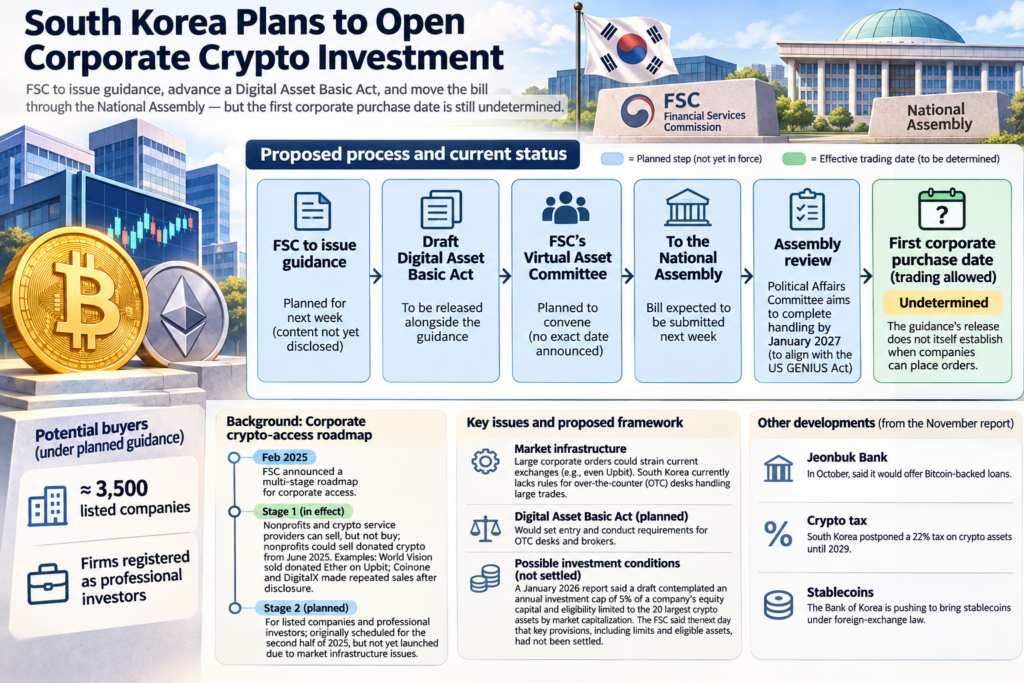
As reported on November 18, 2026, South Korea’s Financial Services Commission (FSC) planned to issue guidance the following week that would allow roughly 3,500 listed companies, as well as firms registered as professional investors, to buy Bitcoin and other crypto assets for investment, according to Bitcoin Magazine. The guidance had not yet been published, and its release would not itself establish when listed companies could place their first orders.
The FSC planned to release the guidance alongside a draft Digital Asset Basic Act and convene its Virtual Asset Committee, though no exact date had been announced. The bill was expected to go to the National Assembly the following week. Its Political Affairs Committee aimed to complete its handling by January 2027 to align with implementation of the US GENIUS Act. These were plans, not rules already in force.
The move would follow the corporate crypto-access roadmap the FSC announced in February 2025. Its first stage allowed nonprofit organizations and crypto service providers to sell, but not buy: nonprofits could sell donated crypto from June 2025. World Vision sold donated Ether on Upbit, while Coinone and DigitalX made repeated sales of their own holdings after disclosure.
The second stage, intended for listed companies and professional investors, had originally been scheduled for the second half of 2025. Market infrastructure remained an obstacle. An industry source said that if companies each traded 5 billion won, even Upbit would struggle to handle the orders; South Korea had no rules for over-the-counter desks handling large trades. The proposed basic act would set entry and conduct requirements for such desks and brokers.
The planned corporate guidance’s terms were not disclosed. A January 2026 report said a draft contemplated an annual investment cap of 5% of a company’s equity capital and eligibility limited to the 20 largest crypto assets by market capitalization. The FSC responded the next day that key provisions, including limits and eligible assets, had not been settled.
Other developments noted in the November report included Jeonbuk Bank’s October statement that it would offer Bitcoin-backed loans, South Korea’s postponement of a 22% crypto tax until 2029, and the Bank of Korea’s push to bring stablecoins under foreign-exchange law. The FSC still needed to clarify when listed companies could begin trading.