
Originally reported by The Block on November 10, 2026, at 14:18 UTC+8.
Coinbase, Kalshi, Kraken parent Payward, DRW Holdings, Jump Trading and Paradigm have asked a U.S. federal court for permission to file an amicus brief supporting the Commodity Futures Trading Commission (CFTC) in a dispute over single-stock perpetual futures.
The proposed brief responds to a lawsuit filed the previous week by the Capital Markets Alliance (CMA), an industry association whose members include Cboe and Citadel Securities. CMA is seeking to overturn the CFTC’s approval of the products. According to the firms’ court filing, applications by Coinbase, Kalshi and Payward to list perpetual futures tied to U.S. stocks were deemed approved on November 2, 2026. The court has not yet granted the firms permission to file the brief, and the lawsuit’s outcome remains unresolved.
Perpetual futures, or perps, let traders take positions on an asset’s price without owning it and, unlike conventional futures, have no expiration date. The legal dispute is over how single-stock perps should be classified. CMA argues that their lack of an expiration date makes them security-based swaps rather than futures, and that they cannot be listed on CFTC-regulated exchanges. It claims the CFTC exceeded the Securities and Exchange Commission’s authority.
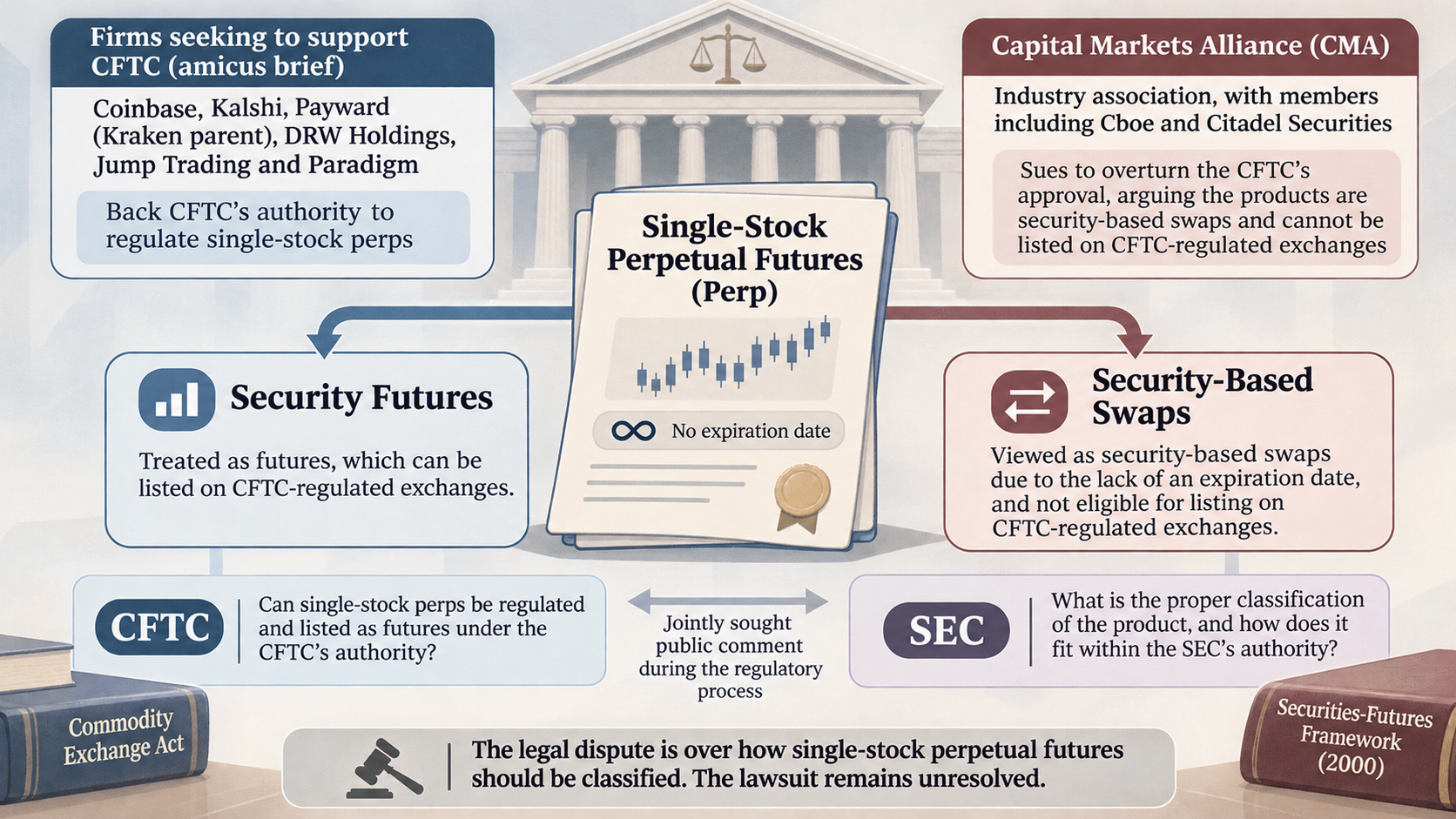
The firms dispute that account. Their filing says the SEC participated in the regulatory process from the start and that the two agencies jointly sought public comment on whether perpetual contracts should be classified as security futures. Coinbase general counsel Molly Abraham separately argued that security futures are not swaps under the Commodity Exchange Act and the securities-futures framework Congress established in 2000.
Source: theblock.co (originally published 2026-11-10 14:18 UTC+8)